Kaufman’s Sailboat
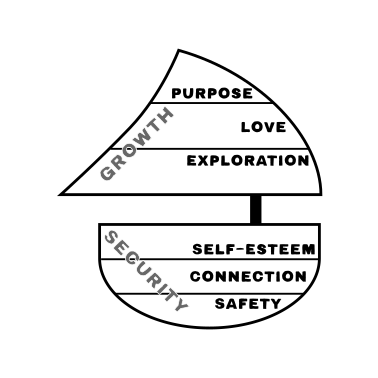
(a great illustrator I am not)
I keep coming back to Scott Barry Kaufman’s sailboat when I try to explain growth to myself. He introduced it in “Transcend: The New Science of Self-Actualization” (2020) as a repair job on Maslow’s hierarchy. Maslow’s original work had more texture than the pyramid poster it became after management consultants got hold of it, and Kaufman tried to put some of that back.
The image is simple: a hull and a sail. The hull is security. If it leaks, nothing else matters for a while. You bail water until the hole is patched. I like that part because it matches how it feels. An unpaid bill or a bad night’s sleep will crowd everything else out.
The hull has three layers. The bottom is safety: food, water, shelter, sleep. Without those covered, attention narrows to survival. Above that is belonging: feeling cared for and included by friends and family. This one is about being on the receiving end, feeling like you count to the people around you. The top of the hull is self-esteem. Once you have a group, you need standing inside it. You need to feel respected for what you contribute, and you need to respect yourself. The two feed each other.
When the hull holds water, attention shifts upward to the sail. Kaufman uses it for growth needs, the stuff that makes a life feel worth living once the basics are covered.
The foot of the sail is exploration. New places, new ideas. Curiosity needs somewhere to go. The middle is love, and he means it in the opposite direction from belonging. Belonging is being cared for. This is caring for other people, out of empathy, and acting on it. The top is purpose. Using what you’re good at for something beyond yourself.
You never finish with one part and move on for good. I patch the hull for a stretch, then catch some wind, then find another leak. A stretch of unemployment or illness can pull anyone back to hull work. A good run can put the sail back up. That back-and-forth is normal.
I lean on this model because it pairs well with Dabrowski’s Theory of Positive Disintegration. The hull is what keeps you steady enough to avoid getting stuck in the Unilevel Loop of Increasingly Uncomfortable Stagnation. The sail is what pulls you through the harder multilevel stretches, where old certainties come apart and something new has to form.